
Home-based consultancy (with travel): Social and Behaviour Change Expert (74 days)
Apply now
Job no: 541934
Contract type: Consultancy
Level: Consultancy
Location: Switzerland
Categories: Communication for Development (C4D)
UNICEF works in some of the world’s toughest places, to reach the world’s most disadvantaged children. To save their lives. To defend their rights. To help them fulfill their potential.
Across 190 countries and territories, we work for every child, everywhere, every day, to build a better world for everyone.
And we never give up.
For every child, results
In Central and Eastern Europe and Commonwealth of Independent Countries, there are estimated 5.1 million children with disabilities[1], and only 1.5 million are recognized as having a disability. Some 3.6 million children with disabilities remain out of any social registers. There are high levels of discrimination and stigma towards children with disabilities, resulting in mass institutionalization, segregated education provision, and exclusion within home, as children with disabilities are often denied participation in the society have no access to services[2].
Out of the total 1.5 million children registered with a disability, 219,000 or 14.5 per cent attend special schools, and it is likely that the remaining 1,281,000 children registered with disabilities – as well as the estimated 3.6 million children with disabilities who are not registered, are out of school or at risk of dropping out[3]. Children in residential care are often excluded from education. Enrolment at pre-school and secondary levels is particularly low. In half of the countries in the region, only less than one percent of all children in primary education are children with disabilities, and majority of these children are in special schools. Children with intellectual disabilities and those with disabilities from birth are particularly at risk of being excluded. In North Macedonia, Serbia, Tajikistan, girls with disabilities have lower access to education than boys[4]. In many countries in Central Asia, home schooling is the main education provision for children with disabilities.
Roma children are another marginalised group in the region. In South Eastern Europe, approximately 1.7 million of the Roma population are children.[5] Roma children in these countries are among the poorest and most excluded members of society. They lack access to adequate housing, health care, education and social services. A significant number are not registered at birth, making it harder to access basic services such as health and education.[6]
Negative attitudes and harmful beliefs, norms and behaviours are the most significant barrier faced by children with disabilities, Roma children and children from other marginalized groups (children left behind by migrant parents; children belonging to some ethnic minorities; migrant and refugee children and others), manifested in violation of the rights, including the rights to education. The resistance by society, parents and other children often results in these children being kept at home, or dropping out from schools. At the same time, research shows that the teaching staff themselves have often negative attitudes towards these children and fail to create a supportive environment in the classrooms and educational facilities. This often reflect the situation in the communities they leave, teachers sharing similar attitudes and norms as the rest of the population. The negative attitudes of communities towards children with disabilities, those belonging to specific ethnic minorities put pressure on school not to accept them in mainstream schools, or to include them in segregated classes.
Teachers (and educators) are in a key position to synchronise the obligations towards individual children in respect of their right to education with system change. They are the link between the education system and the children, and are mandated to transmit the values, social norms as incorporated in policies, regulations, the curriculum or teaching materials. Teachers can be barriers to change or change agents, depending on how they interpret their mandate. Many countries in the region are currently implementing reforms to make schools more inclusive and improve learning outcomes for all children. However, as teachers are (among) the ones to engage with children and communities and translate national policies into quality inclusive education processes, they need adequate knowledge, attitudes and competencies for this purpose.
Evidence shows that the factor with highest impact is teacher’s estimates of student achievement, which determine the kinds of activities and materials provided to students and influence questioning strategies, student groupings and teaching strategies. Other factors with lower impact are teacher credibility, teacher clarity, not labelling students and student-teacher relationship.
Another teacher-related factor with the high positive impact on student achievement is the collective teacher efficacy, a sense of being able to make a difference as a school. This evidence highlights the importance of helping teachers to find ways out of their isolation as a “servant of the state” charged with the education of an isolated group of learners. Lack of collective teacher efficacy may result in schools that feel out of control, due to school regulations, community characteristics, lack of respect and adequate working conditions etc. Disempowered schools are not able to provide an adequate learning environment, especially for marginalised children that are perceived hard to teach or hard to reach.
Traditionally, teachers are taught to pay special attention to certain groups that are at risk of marginalisation or exclusion. This group-based thinking was introduced to ensure the rights of vulnerable groups, but it has been a source of discrimination as well. If teachers are to effectively teach all students, there is a need for a unifying conceptualisation of difference that is not (exclusively) based on pre-defined groups and can accommodate the phenomenon of intersectionality of various dimensions of difference.
In general, teachers’ attitudes towards inclusive education are more positive if they feel well prepared to manage diversity. Lack of knowledge and personal experience increases avoidance behaviour, leading to less interaction and effort and subsequently to more anxiety (Shannon 2009). A low sense of self-efficacy is associated with negative attitudes. Providing relevant knowledge and information as well as opportunities to reflect on attitudes, mindsets and subjective theories can make a difference for teachers’ sense of preparedness and therefore self-efficacy beliefs related to inclusive education (Vaz et al. 2015).
Acknowledgment of and managing student diversity requires “open-mindedness”: tolerance for ambiguity, conflicting perspectives of different stakeholders (e.g. about source of problems) and seemingly irreconcilable directives (e.g. treat all children the same vs. treat them differently) (Sapon-Shevin & Zollers 1999, Elik 2010, Bautista 2018), which is associated with democratic values (e.g. when resolving conflicts) and the ability to manage uncertainty.
Different perspectives of parents and teachers related to students’ needs or problems easily create barriers that need to be addressed without the use of institutional power. Procedures to manage collaborative problem-solving processes provide important guidance in managing uncertainties related to diverse classrooms. Conflict-resolution skills and managing stressful situations may therefore contribute substantially to the realisation of inclusive education.
To address school exclusion of children with disabilities, Roma children and children from other marginalized groups, UNICEF is supporting the governments in the region to develop inclusive education policies and services. Currently, inclusive education is implemented in 20 countries in the region. A set of materials to support capacity development of teachers have been developed, including Training of Trainers modules on inclusive education (see: http://www.inclusive-education.org/sites/default/files/uploads/ToT_Module%201.pdf). These training modules aim to equip teachers with adequate knowledge and competencies to translate inclusive education policies into their classrooms.
In 2019, UNICEF developed a regional training module and a manual on inclusive education to address teaching staff self-efficacy, attitudes, beliefs and norms to promote and support inclusion of every child, regardless of their social and ethnic backgrounds (“Changing perceptions – empowering teachers”). The module complements the inclusive education training package and aims to address teachers’ bias, their negative attitudes and beliefs and build actionable knowledge, rather than knowledge about theories and concepts. The training module has a rights-based approach, and aims to build teachers feeling of self-efficacy to support and promote inclusive education, addressing teaching staff negative attitudes, beliefs and norms around children with disabilities, children belonging to ethnic minorities and children from other vulnerable groups, empowering teachers to promote and support diversity in the classroom and in their interaction with parents and other community members.
How can you make a difference?
UNICEF Regional Office for Europe and Central Asia is looking for an expert on social and behaviour change (SBC), to revise/update, test, adapt and finalize the training module on interpersonal communication for inclusive education, which address teaching staff self-efficacy, attitudes, beliefs and norms to promote and support inclusion of every child, regardless of their social and ethnic backgrounds. The finalized training module and manual will be used in education programmes supported by UNICEF and addressed to teachers in all countries in the region.
The SBC consultant will:
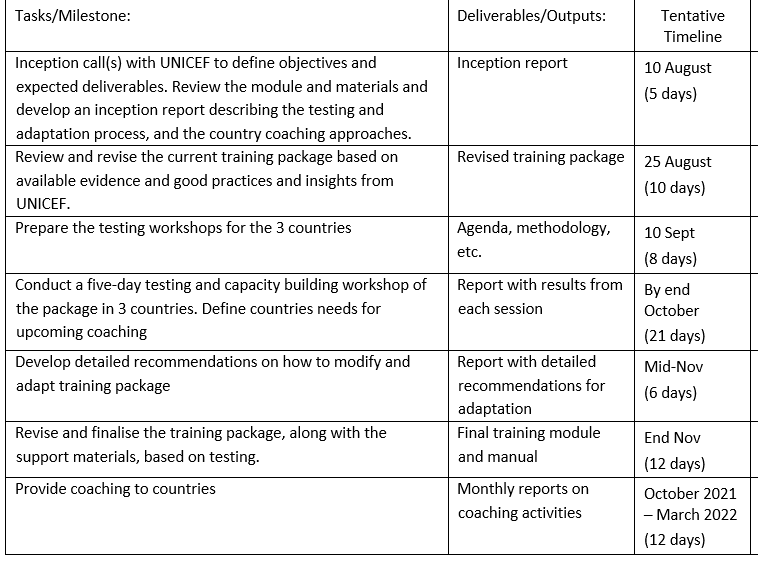
- Develop a concept note / roadmap to describe the process: to revise/update the module based on existing evidence and good practices; test it in 3 countries in the region – Armenia, Bulgaria and Montenegro – (objectives, content and proposed teaching approaches and activities, assessment tools etc.) with both pre-school teachers and primary/secondary education teachers, during a 5-days workshop; adapt it and finalize it based on observations, feedback and recommendations from participants and lessons learned. The in-country workshops will aim to test the module and to build national capacities to deliver similar activities at country level.
- Compile a report on feedback, observations and lessons learned from participants, staff and consultant that will influence the adaptation of the module.
- Finalize the current training module to incorporate recommendations resulting from testing. The module will have a comprehensive section on adaptation (for pre-school educators, teachers in primary and secondary education; for different countries context) and potential use by countries and will contain a list of relevant resources, including identified during the engagement with countries.
- Develop, plan and facilitate online sessions and coaching with trained teachers in 3 countries, in collaboration with UNICEF Regional Office and Country Offices, to help them adapt, explore entry points for training module use and mainstreaming.
The SBC consultant will work jointly with a consultant on Inclusive education on this assignment. The SBC consultant will act as team lead, consulting and integrating the inputs from the Inclusive Education consultant. The consultant is expected to implement all activities from August 2021 to March 2022, in close consultation with UNICEF Regional Office and County Offices. The consultants will consult each draft of the deliverables with the UNICEF ECARO and will reflect all comments and recommendations in the next versions of the deliverables.
Performance indicators for evaluation of results:
The performance of work will be evaluated based on the following indicators:
- Completion of tasks specified in ToR.
- Compliance with the established deadlines for submission of deliverables.
- Quality of deliverables.
- Demonstration of high standards of work.
Contractual modalities:
- Location: The consultant will be home-based, with travel to three countries (Armenia, Bulgaria and Montenegro) to test the training module.
- Payment: UNICEF will issue a consultancy contract in USD. The payment will be made in USD by bank transfer in three instalments:
- 40 per cent, after delivery of the concept note/roadmap, revised training module and materials for module pretesting.
- 40 per cent, after submission of the finalized training package.
- 20 per cent, after submission of the final coaching report.
The consultant will send invoice and payment will be made upon satisfactory completion of deliverables. If the reports and documents are not submitted per the deliverables and timeframe stated in this TOR, the payments will be withheld.
UNICEF reserves the right to withhold all or a portion of payment if performance is unsatisfactory, if work/outputs is incomplete, not delivered or for failure to meet deadlines. All materials developed will remain the copyright of UNICEF and UNICEF will be free to adapt and modify them in the future.
-
Reporting: The consultant will be supervised by and will report to the Regional C4D Specialist. The deliverables to be submitted by the consultant will also be reviewed by the RO Education and Early Childhood Development teams. Regular emails and phone/Skype calls will be used to update the supervisor.
- Travel: the consultant is expected to travel to Armenia, Bulgaria and Montenegro for 3 five-day workshops. Travel related costs have to be included in the financial offer. Travel expenses and accommodation will be covered by the consultant and will be reimbursed by UNICEF upon submission of receipts. The travel costs reimbursed shall be based on economy class travel and the costs for accommodation, meals and incidentals shall not exceed applicable DSA rates as per UNICEF rules and regulations. Agreement with UNICEF is required previous purchasing of flight tickets or other onerous travel arrangements.
To qualify as an advocate for every child you will have…
- An advanced university degree (Master’s) in social sciences, preferably on social and behaviour change, communication for development, social psychology.
- At least 7 years of experience in working on behaviour and social change, addressing negative attitudes and social norms affecting social inclusion of vulnerable children. Proven knowledge on interpersonal communication and community engagement.
- Experience in developing training modules and materials (samples of previous work to be submitted). Experience in facilitating training/capacity building activities, including trainings of trainers.
- Preferred experience in developing and implementing social and behaviour change activities with focus on inclusive education.
- Understanding of the education systems in Europe and Central Asia countries is an asset.
- Excellent command of English. Knowledge of the languages of ECA region will be considered as an advantage.
-
Familiarity and experience working with the UN (ideally with UNICEF) is preferred.
For every Child, you demonstrate…
UNICEF’s values of Care, Respect, Integrity, Trust, and Accountability (CRITA) and core competencies in Communication, Working with People and Drive for Results.
To view our competency framework, please visit here.
Click here to learn more about UNICEF’s values and competencies.
UNICEF is committed to diversity and inclusion within its workforce, and encourages all candidates, irrespective of gender, nationality, religious and ethnic backgrounds, including persons living with disabilities, to apply to become a part of the organization.
UNICEF has a zero-tolerance policy on conduct that is incompatible with the aims and objectives of the United Nations and UNICEF, including sexual exploitation and abuse, sexual harassment, abuse of authority and discrimination. UNICEF also adheres to strict child safeguarding principles. All selected candidates will be expected to adhere to these standards and principles and will therefore undergo rigorous reference and background checks. Background checks will include the verification of academic credential(s) and employment history. Selected candidates may be required to provide additional information to conduct a background check.
Applications
Interested applicants should submit:
- A CV and/or Personal history form (downloadable from http://www.unicef.org/about/employ/files/P11.doc). Alternatively, if a candidate profile in the UNICEF e-Recruitment System is available, you may download it and submit it as part of application.
- A financial offer, with a daily rate in USD. The financial offer will also include the costs for the three travels to countries, to deliver the 5-day workshops.
- Any sample of previous work, relevant to this consultancy.
Remarks:
Only shortlisted candidates will be contacted and advance to the next stage of the selection process.
Individuals engaged under a consultancy or individual contract will not be considered “staff members” under the Staff Regulations and Rules of the United Nations and UNICEF’s policies and procedures, and will not be entitled to benefits provided therein (such as leave entitlements and medical insurance coverage). Their conditions of service will be governed by their contract and the General Conditions of Contracts for the Services of Consultants and Individual Contractors. Consultants and individual contractors are responsible for determining their tax liabilities and for the payment of any taxes and/or duties, in accordance with local or other applicable laws.
[1] World Disability Report (2011) estimates 5.1 per cent of the child population 100 million in the region, with 0.7 per cent of children 0-14 years of age having a severe disability.
[2] UNICEF CEE/CIS, Regional Out-of- school report, 2015
[3] UNICEF CEE/CIS Regional Out-of- school report, 2015 p.2&13
[4] TransMonEE, 2014
Advertised: W. Europe Daylight Time
Deadline: W. Europe Daylight Time
Back to search results Apply now Refer a friend
To help us track our recruitment effort, please indicate in your cover letter & on the application form where (ngotenders.net) you saw this job posting.
Share this:
|
More