
Home-based Consultancy to support strengthening the implementation of national health policies for the ‘Refugee and Migrant Children’s Health Status in Southern and South-East Europe’ Project (42 days)
Apply now
Job no: 538996
Contract type: Consultancy
Level: Consultancy
Location: Switzerland
Categories: Consultancy
UNICEF works in some of the world’s toughest places, to reach the world’s most disadvantaged children. To save their lives. To defend their rights. To help them fulfill their potential.
Across 190 countries and territories, we work for every child, everywhere, every day, to build a better world for everyone.
And we never give up.
For every child, results
Between 2014 and 2018, some 1.3 million children sought international protection in Europe, fleeing conflict, insecurity and lack of opportunities in Syria, Afghanistan, Iraq, and in countries in sub-Saharan Eastern and Western Africa. They include over 225,000 unaccompanied and separated children – the majority of whom are adolescent boys (15-17 years old), as well as an estimated 500,000 infants and children under the age of five.
Countries in Southern and South-Eastern Europe have been at the forefront in receiving children on the move over the past few years. In 2018 alone, some 141,600 refugees and migrants undertook treacherous sea and land journeys to reach Greece, Bulgaria, Italy and Spain in the hope of safety, protection and better opportunities for themselves and their families. This included some 30,000 children, over a third of whom (12,700) were either making the journey alone or became separated from their families while en route.
Despite measures to prevent irregular migration, Mediterranean routes, particularly in the East and West, continue to see a significant number of new arrivals and an increase in the proportion of children. As of June 2019, some 42,000 refugee and migrant children were present in reception facilities in Greece, Italy and the Balkans.
The circumstances encountered by refugee and migrant children before, during and after displacement and migration severely impact their health outcomes. In countries of origin, the widespread breakdown of health systems and health services often result in children being inadequately protected from vaccine-preventable diseases. Crowded and unhygienic living conditions in transit and in destinations further increase their risks of acquiring bacterial, viral and parasitic infections. Skin and eye infections (e.g., scabies and conjunctivitis) and upper respiratory tract infections are often identified among refugee and migrant children rescued at sea.
The 24-month ‘RM Child-Health’ initiative, which began in January 2020, aims to help improve the health of children on the move in Bosnia and Herzegovina, Bulgaria, Greece, Italy and Serbia. With European Union funding support, under the Directorate General for Health and Food Safety, UNICEF is working with its partners on the ground to implement tailored interventions to address critical gaps and bottlenecks with regards to healthcare provision by national authorities and policy implementation, which impact refugee and migrant children’s health status, in the following four areas:
- Primary health care, including immunization,
- Mental health and psychosocial support (MHPSS),
- Gender-based violence (GBV) prevention and response,
- Maternal and child health, including infant and young children feeding (MCH and IYCF).
All interventions are being designed in line with human rights principles and standards and build on existing cooperation frameworks between UNICEF and Governments (Country Programme Documents) in Project countries, ongoing activities within the UNICEF refugee and migrant response in Europe, and commitments under its Strategic Plan 2018-2021. The project pursues the following three objectives:
- Strengthening national authorities’ capacity to provide healthcare to refugee and migrant children,
- Increasing health literacy among refugee and migrant children and their parents,
- Strengthening implementation of national health policies.
How can you make a difference?
UNICEF ECARO is seeking a Consultant to provide guidance and sound technical advice to Project Focal Points, and support to authorities to address relevant policy/procedural bottlenecks in Bosnia and Herzegovina, Bulgaria, Greece, Italy and Serbia, with the aim to strengthen implementation of national health policies. He/she will develop country specific, gender sensitive policy briefs and advocacy packages, aimed at removing procedural or administrative barriers that prevent or limit refugee and migrant children’s access to primary and specialized health services. The consultant will also develop a regional policy brief to capture promising practices from Project countries and outline key recommendations for the improvement of refugee and migrant children’s health status in Project countries and beyond, eventually contributing to the final regional assessment report of the Project.
Methodology
The consultant will initiate discussions with Country Office staff, facilitate focus group discussions, and will be expected to use a combination of different analytical techniques, tools and processes as appropriate given the specific contexts and data availability, to identify the main bottlenecks and barriers.
Specific Objectives
- Hold initial discussions with project offices to define ways of working and level of support needs;
- Review existing policy frameworks, information related to provision of essential service, standard operational guidelines and best practices aimed at strengthening RMC Health status. (This includes, but is not limited to, specific evidence collected through participation in the cross-sectoral coordination mechanisms; project implementation documents such as service providers mappings, analysis of standards of care, standard operating procedures, referral pathways; and experiences in evidence-based advocacy for targeted interventions (e.g. catch-up vaccination campaigns, referral of children and adolescents showing signs of psychosocial distress or mental health issues and survivors of GBV).
- Support Country Offices in documenting these efforts, identifying key bottlenecks for effective service provision and developing the country specific policy-advocacy brief. The consultant will help offices to identify commonalities and differences between the contexts, and foster exchanges on lessons learned and good practices between project countries. The cross-sectoral approaches will be promoted to respond to refugee and migrant children’s health needs in a holistic and integrated manner.
- The Consultant will develop a regional policy brief capturing lessons learned and promising thematic practices emerging from the Project. The brief will inform broad recommendations to strengthen the health status of refugee and migrant children in Project countries and Europe more broadly. Its findings and recommendations will feed the regional assessment report (including country-specific chapters) and guide further regional advocacy and national system-building approaches.
Duration and Deliverables
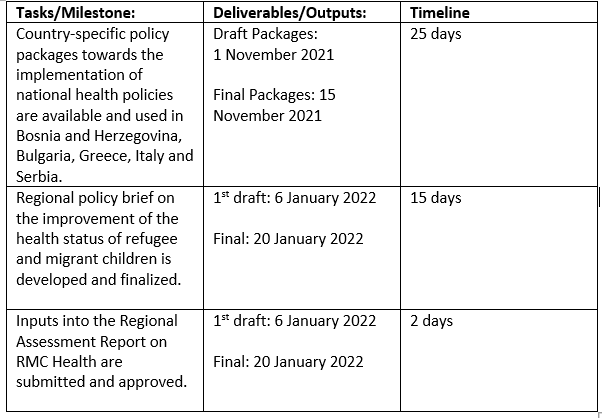
The consultancy is expected to be for a maximum of 42 days carried out between May 2021 and April 2022. The following deliverables are expected:
- Five country-specific policy packages towards the implementation of national health policies
Country-specific policy packages will include country mappings, referral pathways and SoPs, etc., aiming to remove existing bottlenecks towards the operationalization of national health policies related to refugee and migrant children and caregivers. These will include, but not be limited to: Entity/Cantonal health response plan; MHPSS referral pathways in place for refugee/migrant children in Una-Sana Canton (BiH); Mapping of health and PSS services; Referral mechanism for asylum-seeking and refugee children in need of psychiatric support (Bulgaria); Mapping of GBV service providers; Referral mechanism for refugee and migrant GBV survivors to state-run shelters and counselling centres (Greece); Mapping on best practices and factors of success on MHPSS services; Referral mechanism for refugee and migrant children in need of MHPPS (Italy); RM Health Coordination and SoP for MHPSS referrals (Serbia).
- Regional policy brief on the improvement of the health status of refugee and migrant children
A regional policy brief to capture promising practices from Project countries and outlining key recommendations for the improvement of refugee and migrant children’s health status in Project countries and beyond.
- Inputs into the Regional Assessment Report on RMC Health
Based on the findings from the country packages and regional brief, provide inputs for the final regional assessment report.
Payments
The consultant will be paid on the basis of working days and upon satisfactory completion of each deliverable and submission of a brief narrative report.
Management and Supervision
The consultant will work under the direct supervision of the UNICEF ECARO Regional Health Advisor, and in close collaboration with the Programme Associate, Project focal points and other relevant colleagues from participating country offices, as well as the Health team in the ECA Regional Office, and other RO colleagues.
Performance Indicators for Evaluation of Results
- Timely delivery of outputs according to agreed schedule
- Satisfactory feedback from country office staff relating to technical support
- Satisfactory quality of final products
Performance will be monitored throughout the duration of the consultancy through regular calls and a bi-weekly progress note. Performance will also be analyzed after delivery of the final products and before final payment.
Conditions of Work
- The assignment is home-based with no travel envisaged. The consultant(s) will work directly with UNICEF staff in ECARO and country offices through remote means.
- No work or travel may commence unless the contract is signed by both UNICEF and the consultant
- The consultant/s shall use their own facilities to manage the work, but, where circumstances demand otherwise, shall be allowed to make use of available UNICEF office space, computer and internet facilities with prior notification and arrangement with the supervisor and UNICEF Admin/ICT. The provision of these facilities by UNICEF shall be subject to their availability.
- The estimated cost of the consultancy is up to 42 working days. The Consultant shall indicate their daily fees in their application.
- UNICEF will issue a consultant contract in USD. The payment will be made in USD by bank transfer and in instalments upon deliverables as per contractual agreement.
- Reservations: UNICEF reserves the right to terminate the contract without a prior notice and/or withhold all or a portion of payment if performance is unsatisfactory, if the rules and the regulations regarding confidentiality, ethics and procedures of UNICEF and the project partners are not followed, if work/outputs are incomplete, not delivered or for failure to meet deadlines.
- The candidate will be selected based on “best value of money” and will be governed by and subject to UNICEF’s “General Terms and Conditions for individual contracts.”
To qualify as an advocate for every child you will have…
- Advanced University Degree in Public Health, Social Policy, International Development or related discipline.
- A minimum of 8 years relevant professional experience in public health and social protection in an advisory capacity or direct implementation experience in Europe and Central Asia preferred;
- Demonstrated experience in conceptualizing multi-and-cross-sectoral policy briefs (Health, Nutrition, Gender Based Violence, Mental Health and Psychosocial support) in EU and Accession Countries of SEE;
- Demonstrated experience on different assessment tools (needs, assessments, capacity assessments) and analytical tools (bottleneck analysis);
- Demonstrated experience working in emergency/humanitarian contexts
- Demonstrated experience providing technical assistance, and guidance, capacity building and mentoring of professional staff;
- Excellent analytical, writing, communication skills;
- Proven ability to manage multi-sector projects;
- Fluency in verbal and written English is required; Knowledge of another regional language would be appreciated.
For every Child, you demonstrate…
UNICEF’s values of Care, Respect, Integrity, Trust, and Accountability (CRITA) and core competencies in Communication, Working with People and Drive for Results.
To view our competency framework, please visit here.
Click here to learn more about UNICEF’s values and competencies.
UNICEF is committed to diversity and inclusion within its workforce, and encourages all candidates, irrespective of gender, nationality, religious and ethnic backgrounds, including persons living with disabilities, to apply to become a part of the organization.
UNICEF has a zero-tolerance policy on conduct that is incompatible with the aims and objectives of the United Nations and UNICEF, including sexual exploitation and abuse, sexual harassment, abuse of authority and discrimination. UNICEF also adheres to strict child safeguarding principles. All selected candidates will be expected to adhere to these standards and principles and will therefore undergo rigorous reference and background checks. Background checks will include the verification of academic credential(s) and employment history. Selected candidates may be required to provide additional information to conduct a background check.
To apply:
Candidates are invited to
- complete their UNICEF profile
- attach latest P-11 History Form, CV and Motivation Letter (http://www.unicef.org/about/employ/index_53129.htm)
- Indicate a daily fee. Applications without fees will not be accepted.
Remarks:
Only shortlisted candidates will be contacted and advance to the next stage of the selection process.
Individuals engaged under a consultancy or individual contract will not be considered “staff members” under the Staff Regulations and Rules of the United Nations and UNICEF’s policies and procedures, and will not be entitled to benefits provided therein (such as leave entitlements and medical insurance coverage). Their conditions of service will be governed by their contract and the General Conditions of Contracts for the Services of Consultants and Individual Contractors. Consultants and individual contractors are responsible for determining their tax liabilities and for the payment of any taxes and/or duties, in accordance with local or other applicable laws.
Advertised: W. Europe Standard Time
Deadline: W. Europe Daylight Time
Back to search results Apply now Refer a friend
To help us with our recruitment effort, please indicate in your cover letter & on the application form where (ngotenders.net) you saw this job posting.
Share this:
|
More