
Local individual contractor: Social Policy Expert, Italy (11.5 months)
Apply now
Job no: 536744
Contract type: Consultancy
Level: Consultancy
Location: Italy
Categories: Consultancy
UNICEF works in some of the world’s toughest places, to reach the world’s most disadvantaged children. To save their lives. To defend their rights. To help them fulfill their potential.
Across 190 countries and territories, we work for every child, everywhere, every day, to build a better world for everyone.
And we never give up.
For every child, results
The fundamental mission of UNICEF is to promote the rights of every child, everywhere, in everything the organization does — in programs, in advocacy and in operations. As part of its efforts to provide all children with an equitable chance in life, UNICEF works to identify, monitor, and effectively address the underlying causes of child poverty and social exclusion.
Despite the strength of the European economy and a tradition of investment in the welfare of the most vulnerable citizens, nearly one-quarter of Europe’s children remained at risk of poverty and social exclusion as of 2018.[1] Poverty and deprivation in childhood can have lifelong detrimental impacts, undermining an individual’s health, educational attainment, income earning capacity, and social connection, and contributing to an increased risk of exposure to violence, among others. The EU has long recognized the need to address entrenched issues of child poverty and social exclusion, including through a call by the European Parliament for a Child Guarantee to reduce inequalities. As families, societies, and governments around the world struggle to cope with the devastating impacts of COVID-19, which are expected to result in significant economic contraction, employment impacts, and a likely increase in poverty, these efforts have taken on a new urgency.
The multidimensional and highly inter-connected nature of poverty and social exclusion calls for the development of a wide spectrum of comprehensive policies, including measures to support income growth, to address material deprivation and to provide integrated social services that are designed to increase the access of the most vulnerable to existing support mechanisms. On the grounds of their social exclusion and marginalization, children exposed to the risk of poverty are often kept from accessing sufficiently high-quality basic services such as healthcare or education. Such lack of access enhances in turn the risk of poverty and places a child at risk of a cycle of persistent, sometimes life-long poverty and disadvantages. For many children, an improved “care” component represents therefore a pre-condition to achieve equity in accessing existing services. Access to education, healthcare, adequate nutrition, decent housing and care, especially by children pertaining to one of the four groups identified by the EU as particularly vulnerable to poverty and social exclusion[2], may be achieved through their integration into family and community-based services, whereas solutions are generally grounded in achieving sustainable shifts to supported family- and community-based care.
Poverty may be considered as a violation of child’s rights, e.g. by depriving them of their right to an adequate standard of living and to be free from deprivations across crucial aspects of their lives, including their health, education, nutrition, care and protection. Child poverty may also have broader impacts on societies and economies: poverty is felt immediately by children themselves, but it also represents a loss of potential that Europe’s aging societies cannot afford. People who have experienced poverty as children are at higher risk to become unemployed, poor, and excluded during their adult lives. Research confirms that poverty and deprivation in childhood have both short- and long-term effects, causing an intergenerational cycle of disadvantage.[3]
In view of the above, the EU has mandated the UNICEF’s Regional Office for Europe and Central Asia with the verification of the feasibility of the Child Guarantee in selected EU Member States. In order to do so, UNICEF ECARO and UNICEF Country Offices, together with their implementing partners, will carry out a number of activities including a EU-wide meta-analysis and nation-specific deep dive analysis aimed at supporting the governments in the development of an Action Plan on the reduction of Child Poverty and Social Exclusion.
The deep dive analysis will be conducted in seven EU countries, one of which being Italy where, of the 10 million children and young people under the age of 18, more than 1.2 million live in absolute poverty. Additionally, 25.7% of youth aged 18 to 24 are currently not in education, employment, or training. The disparity in the level and access to services between different areas of the country is alarming. Italian children and adolescents are also between those more at risk of poverty and social exclusion (30.6%) compared to the EU average (23.4%).
Given the complexity and inter-institutional nature of the deep dive analysis and development of the action plan, a Steering Committee is being formed between involved institutions and UNICEF. The UNICEF Office of Research – Innocenti, will also provide support in the process.
How can you make a difference?
UNICEF is seeking an individual contractor to support and coordinate the process of deep dive analysis and to coordinate the process and lead the development of an Action Plan on the reduction of Child Poverty and Social Exclusion.
The deep dive analysis to be supported, will have the following main results:
- Provide a comprehensive, evidence-based, and nationally-endorsed analysis of the impacts of the ways in which national and subnational policies, programmes, systems, processes, and mechanisms have either contributed to or detracted from the success of efforts to address child poverty and social exclusion, including that of the four Target Groups (Children in precarious family situations (including children from marginalized populations), children residing in institutions, children with a migration background, and children with a disability and/or special needs).
- Identify bottlenecks and opportunities to achieving sustained reduction of poverty and social exclusion for the 4 TGs, including through identification of effective and evidence-based services, interventions, and/or mechanisms of support.
- Review and provide recommendations on the availability of national data and statistics to effectively monitor the reduction of child poverty and social exclusion, including disaggregated data for the 4 TGs.
The Action Plan will be built based on the findings and recommendations of the deep dive analysis and in coordination and consideration of Italy on going planning, by May 2021.
Specifically, the individual contractor will be in charge of:
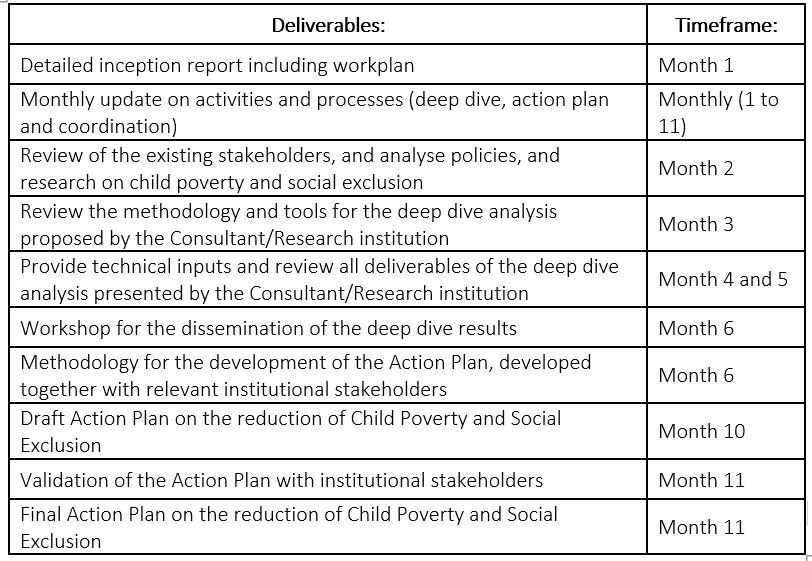
Technical support to the deep dive analysis:
- Conduct a rapid review of existing stakeholders, and analyse policies, and research on child poverty and social exclusion and develop detailed conceptualization of the analysis.
- Support the office to identify the (Consultant/Research institution) to conduct the deep dive analysis.
- Review the methodology and tools for the deep dive analysis proposed by the Consultant/Research institution.
- Provide technical inputs and review all deliverables of the deep dive analysis presented by the Consultant/Research institution.
- Support the validation process.
- Support the dissemination activities of the deep dive analysis.
Technical support to the action plan:
- Identify, together with partners, key policy and entry points for the development of national or subnational Action Plans on Combatting Child Poverty and Social Exclusion. This may include, for example, links to existing national poverty reduction or child rights strategies.
- Support Governmental partners, through the Child Guarantee Technical Steering Committee, in the development of an action plan on the reduction of Child Poverty and Social Exclusion, based on the findings and recommendations of the deep dive analysis.
Coordination and engagement of stakeholders:
- Support and facilitate the activities of the Child Guarantee Technical Steering Committee.
- Facilitate the coordination between all institutional actors and plans involved in Child Poverty (e.g. Osservatorio nazionale per l’infanzia e l’adolescenza, lavori preparatori del nuovo Piano per gli interventi e i servizi sociali di contrasto alla povertà 2021/2023 etc.)
Contractual arrangements:
- Estimated Duration of the Contract: The contract duration will be 11.5 months (full time).
- Payments: The individual contractor will be paid monthly based on satisfactory and timely delivery of outputs. Each request for payment must be supported by the supervisor’s written certification of the assignment performed. Final payment is made only upon certification of the satisfactory completion of the assignment as a whole, and completion by the supervisor of the evaluation.
- Nature of Penalty Clause in Contract: If the final reports and documents are not submitted according to the deliverables stated in this TOR, the payments will be withheld. UNICEF reserves the right to withhold all or a portion of payment if performance is unsatisfactory, if work/outputs is incomplete, not delivered or for failure to meet deadlines (fees reduced due to late submission: 20 days – 10%; 1 month -20%; 2 months -30%; more 2 months – payment withhold). All materials developed will remain the copyright of UNICEF and UNICEF will be free to adapt and modify them in the future.
- Supervisor: The individual contractor will report to the Italy Country Coordinator, in collaboration with the Child Guarantee Technical Steering Committee and ECARO Social Policy Advisor
- Duty Station and Official Travel: The individual contractor will be based in Italy (ideally Rome), with a combination of remote and office-based. Travel to field locations and Rome (in case the consultant is based elsewhere) is expected to the max of 5 trips. The maximum amount allocated for travel is EUR 3,500. The contractor will be responsible for organizing their travel. All travel expenses (tickets, accommodation, public transport, meals) will be reimbursed, based on invoices.
- Travel Clause:
- All UNICEF rules and regulations related to travel of Consultants/ Individual Contractors apply.
- All travels shall be undertaken only upon the prior written approval by UNICEF.
- The consultant should travel via the most economic and direct route.
- Travel costs will be reimbursed after the completion of mission.
- The consultant must be fit to travel, be in a possession of the valid UN BSafe certificate, obligatory inoculation(s) and have a valid own travel/medical insurance and an immunization/vaccination card
To qualify as an advocate for every child you will have…
Required:
- Advanced degree in law, economics, political science or other relevant social policy background;
- A minimum of ten years of relevant professional work in social policy, including child poverty and social exclusion, and in the development of policy analyses, action plans and strategies;
- Proven experience in conducting and supervising similar analyses (including stakeholder consultations, research management) and producing similar deliverables and producing policy-oriented analysis with clear and monitorable recommendations.
- A deep understanding of the context, policy, and process for child poverty and social exclusion reduction at the national and sub national level in Italy.
- Excellent planning and organizational skills;
- Excellent analytical and written skills;
- Strong communication skills – both oral and written;
- Fluency in Italian and English;
- Good team player.
Desired:
- Demonstrated capacity of engagement of Authorities and relevant stakeholders;
- Experience in working through local and national systems; Professional links/partnerships with relevant national and subnational bodies.
- Previous engagement with and demonstrated understanding of the EU Child Guarantee development process will be an advantage.
- Experience working with UN/international organizations.
For every Child, you demonstrate…
UNICEF’s values of Care, Respect, Integrity, Trust, and Accountability (CRITA) and core competencies in Communication, Working with People and Drive for Results.
View our competency framework at
http://www.unicef.org/about/employ/files/UNICEF_Competencies.pdf
UNICEF is committed to diversity and inclusion within its workforce, and encourages all candidates, irrespective of gender, nationality, religious and ethnic backgrounds, including persons living with disabilities, to apply to become a part of the organization.
UNICEF has a zero-tolerance policy on conduct that is incompatible with the aims and objectives of the United Nations and UNICEF, including sexual exploitation and abuse, sexual harassment, abuse of authority and discrimination. UNICEF also adheres to strict child safeguarding principles. All selected candidates will be expected to adhere to these standards and principles and will therefore undergo rigorous reference and background checks. Background checks will include the verification of academic credential(s) and employment history. Selected candidates may be required to provide additional information to conduct a background check.
To apply:
Applicants are invited to:
- complete their UNICEF profile
- attach P11, CV and Motivation Letter (http://www.unicef.org/about/employ/index_53129.htm)
- Submit a financial proposal with a monthly fee in EUR. Applications without fees will not be accepted.
Remarks:
Only shortlisted candidates will be contacted and advance to the next stage of the selection process.
Individuals engaged under a consultancy or individual contract will not be considered “staff members” under the Staff Regulations and Rules of the United Nations and UNICEF’s policies and procedures, and will not be entitled to benefits provided therein (such as leave entitlements and medical insurance coverage). Their conditions of service will be governed by their contract and the General Conditions of Contracts for the Services of Consultants and Individual Contractors. Consultants and individual contractors are responsible for determining their tax liabilities and for the payment of any taxes and/or duties, in accordance with local or other applicable laws.
[2] Children in precarious family situations (including children from marginalized populations), children residing in institutions, children with a migration background, and children with a disability and/or special needs.
[3] European Parliament Committee on Employment and Social Affairs: “Fighting Child Poverty: the Role of EU Funding”, 2018, p. 18
Advertised: W. Europe Standard Time
Deadline: W. Europe Standard Time
Back to search results Apply now Refer a friend
To help us with our recruitment effort, please indicate in your cover letter & on the application form where (ngotenders.net) you saw this job posting.
Share this:
|
More